

Guide to Tian'anmen Square in Beijing: History, Landmarks, Meaning, Map


The moment you enter Tian'anmen Square for the first time, you may have that not-so-common feeling of stepping into living, standing history.
Indeed, Beijing's main square truly is a place where the complex, intricate experience of an immense country like China finds its home. For many Chinese people, the square is where what moves China takes a tangible form, and you will be able to see for yourself their emotion in visiting it for the first time during your own stroll around this immense, highly politicized place.
Of course, being an incredibly significant, highly politicized space, Tian'anmen, as you will find out, is not the easiest landmark in China to visit: security checks, restricted access, crowds, and pre-bookings can make a nuisance out of a memorable experience. Hopefully, this guide will be able to help you with all chores and, most of all, give you a solid context to let you truly discover Tian'anmen Square.
In this article:
Tian'anmen Square in Beijing: Introduction and History
The Meaning of Tian'anmen Square
What to See in Tian'anmen Square
How to Visit Tian'anmen Square
Tian'anmen Square in Beijing: Introduction and History
INTRODUCTION
I have visited Tian'anmen Square twice, and both times I was stunned by its enormity.
Beijing is a busy, bustling city, and China is, just to put it mildly... crowded. Finding a place where, no matter how many people you stuff in there, it will still be relatively empty truly is amazing, and may make you feel lost, slightly out of place. As we will see, this doesn't happen by chance, as the square is meant to embrace crowds and intimidate loners.
That said, Tian'anmen Square is a unique place in China and in the world, and reasonably one of the biggest public spaces on Earth: with its gigantic proportions, it can accommodate up to 600,000 people - a number that may shock us once we are able to perceive its immensity. And yet, the square did not exist until very recent times, and wasn't even called this, despite Tian'anmen (the Forbidden City's gate) having stood there since the 15th century. Why? Because the area looked very different from now and walls and buildings prevented it from hosting a square. Moreover, the gate itself wasn't as important as it is today. We will cover this and more soon.
One last thing to mention before diving much deeper into the iconic square: despite its name, do not expect Tian'anmen to be the actual focus of it. The real protagonist is definitely Chairman Mao Zedong.
HISTORY OF TIAN'ANMEN SQUARE
An important premise: Technically, the history of Tian'anmen Square begins more or less with that of the Forbidden City, but this may be deceiving. Surely, the square is and has always been linked to the Forbidden City, however, the square as we know it did not emerge until the Republican era of China, particularly after 1911. In any case, for the sake of completeness and to better understand what happened in the 20th century, we will mention all steps.

Tian'anmen Square under the Empire
So, the Forbidden City. The iconic imperial complex was built for the first time in the 15th century, under the Ming dynasty. This included the gate of Tian'an (门 mén meaning gate, indeed), which was first erected in 1417 and completed around 1420.
While the 15th-century version of the gate was not meant to last, the space in front of it kept more or less the same structure for centuries. A T-shaped area, walled up on both sides, opened up in front of the gate, and connected the actual Forbidden City behind it to the administrative parts of the Imperial City, which wasn't as prohibited as the Forbidden one, but still inaccessible to most commoners. The T-shape extended southwards towards the now-disappeared Daming Gate 大明门.
Imperial vs. Forbidden City: The Forbidden City was the imperial palace complex where the emperors and their households lived from the 15th century until 1911. It was highly restricted and generally inaccessible to ordinary people, although authorized visitors could enter. The Imperial City contained government offices and other facilities serving the imperial administration. Access to the area was restricted, but it was open to many officials and governmental workers, and other people with authorized business there.
Obviously, a T-shape could not be as spacious and airy as modern Tian'anmen Square and, indeed, the area was still not intended as a square at all. It was more an avenue, although large, with the symbolic purpose of connecting several parts of the Imperial City while dividing them based on ranking and with the aid of walls. Moreover, representing the ultimate separation between the Forbidden City and the outside world, imperial officials used the space in front of Tian'anmen for communications and trial sentences for centuries. A role Tian'anmen would retain once it became a square.
When the Empire fell in 1911, the T-shape was still in place and the area in front of Tian'anmen had no recognized name nor was it particularly known by Beijingers. After all, it had remained out of their sight for centuries, and had little meaning for them.

The Birth of Tian'anmen Square
After 1911, with the beginning of the Republican era, Beijing changed forever. No longer an imperial city, its core did not revolve around the Forbidden City anymore. While the latter still remained a symbol, the urban architecture of the capital was changing to welcome the new times.
Several public spaces were gradually built to give people places where they could rest and spend their leisure time in a newly transformed city that no longer had specific restricted or forbidden areas. However, these spaces were mostly parks and gardens - the creation of squares was generally avoided to discourage people from gathering and demonstrating in large numbers. After all, those were tumultuous times, and parks had an entrance fee that not everyone could afford. Demonstrations were not easy to organize that way.
And yet, in those years, Beijing and China were boiling. After China became a Republic, much was still undefined and uncertain, and the country was constantly on the verge of turmoil.
Particularly, in 1919, the First World War had just ended and China was profoundly dissatisfied. Having participated in the conflict on the victorious side, the country expected all concessions in the losing countries' hands to be returned. The Treaty of Versailles, however, opted for Japan to retain Germany's former rights and concessions in Shandong. The Chinese people were enraged and during the so-called May Fourth Movement in 1919, they expressed all their contempt.
Where did they express it? As we mentioned, suitable areas were lacking in Beijing, so new solutions were needed. Not knowing where to gather, the protesters (mostly students) opted for a place near the Western delegations that were still crowding the capital. Today's Tian'anmen Square happened to be located right there.
The May Fourth Movement represented a crucial turning point for Tian'anmen Square. The area, now known for having hosted that momentous event, was subsequently chosen for more gatherings, including patriotic marches and demonstrations during the Second World War and the Civil War (1946-1949).
By the time Mao Zedong was about to found the People's Republic of China in 1949, the square, still T-shaped although no longer with the walls that characterized it, was recognized all over China for its political and societal significance. That, together with the symbolic value that Tian'anmen and the Forbidden City added to it, led Chairman Mao to choose it for his historic proclamation speech on October 1st, 1949.

Tian'anmen Square In Mao's Era and Until Today
After the proclamation of the People's Republic and the accumulation of events that took place there, in Mao's era, Tian'anmen Square became indissolubly linked to high power.
Being the place where it all started, Mao Zedong also wanted it to be the place that represented the triumph of the regime. So, soon after 1949, the Chairman approved a plan that would give the square the monumentality we see today.
The major transformations, thus, took place during the 1950s. The square lost its T-shape, was progressively enlarged and its old structures demolished. This is when ancient walls, residential buildings, gates, bridges, pailou (the popular ancient architectural arches you see around Chinese cities and Chinatowns), and roads were destroyed. Unfortunately, while Beijing today is a beautiful, fascinating capital, the amount of what got lost in the 20th century is traumatizing.

The Monument to the People's Heroes was the first one to be conceived, and the first stone was laid in 1949 already. By 1958, it was finished. Then, a decade after the PRC's foundation, in 1959, construction began on most of the buildings we see today: the Great Hall of the People, the National Museum of China, and so on.
The last one to be completed was Chairman Mao Zedong Memorial Hall. Construction began almost immediately after Mao's death in September 1976 and it was completed by 1977.
In the last few decades, not many architectural changes occurred in the square, and when you visit it today, the mark of the 20th-century socialist regime is still strong and visible in colors, shapes, and messages. However, security measures progressively increased over the years.
When my father visited the square in the 1990s, he could still see people playing with and running after their kites. He told me this is, to this day, one of his most vivid and serene memories of China that he keeps.
When I visited it (both times), the experience, although memorable, was far less peaceful. Today, visiting the square requires booking a spot (for free), queuing for an indefinite time (last time it took me almost 2 hours) and going through at least 3 different security checks. While it is definitely worth it in the end, it surely leaves you with the feeling that the square is more of a state property rather than truly belonging to the people.
Naturally, this is the consequence of the past decades and, especially, of the 1989 events and, more recently, of the COVID-19-related protests.
In April 1989, as many of you may know, protests against the government and for democracy and freedom of speech erupted in Beijing, following the death of a renowned reformist, Hu Yaobang 胡耀邦, but actually ignited by the profound changes going on in other Marxist countries in the same period, especially East Germany and the Soviet Union. The protests would continue until June and the situation took a violent turn in the attempt to stop them. Subsequently, the episode (later known in the West as the Tian'anmen Massacre and in China as the June Fourth Incident) would hardly be discussed within China, but it would have strong consequences on how Tian'anmen is administered by the government.
From there, the grip on security would later relax or tighten according to the spirit of the time. At the moment, apparently, it is not a time to rest.
Read more about China on Substack!
Check out "China for Westerners" for regular articles on everything China, including history, culture, and cinema.
The Meaning of Tian'anmen Square
THE PRESENCE OF MAO ZEDONG IN TIAN'ANMEN SQUARE
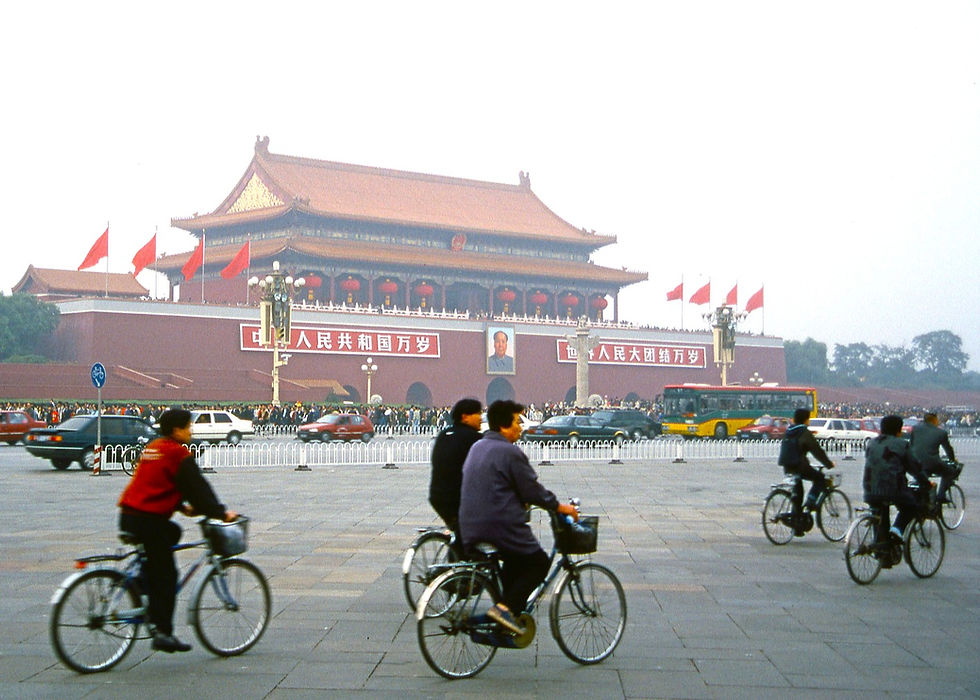
The moment you step into Tian'anmen Square, you realize Mao Zedong is the protagonist and the square could well be called after him.
His iconic portrait is displayed on Tian'anmen, he himself is forever lying in a glass coffin in the Memorial Hall for all visitors to see. And, more than anything, the country he created is symbolically represented across the square through the buildings he erected, the slogans he pronounced, and the mass-centered national identity he contributed to shape.
Visiting Tian'anmen is like walking into the 20th century, and in some way, you perceive how much China is still linked to its Chairman, no matter how much it has changed externally.

Mao Zedong's Portrait
China does not have a long tradition of showing off its leaders. Emperors rarely publicized their image, and portraits were confined to specific occasions and audiences. Their subjects rarely knew much about the monarchs' appearance.
While this partially changed towards the end of the Empire, it was only in the Republican era that China began clearly exposing the face of the person in power. The first one was to be Sun Yat-sen 孙逸仙 in 1929, followed by Chiang Kai-shek 蔣介石a few years later. Soon, these portraits began to embody political authority and became a tradition.
The first portrait of Mao Zedong came, of course, in 1949, when he officially became the Chairman of China. After him, no one really wanted or dared to create a cult of personality like the one Mao did create, and thus no one wanted or dared to remove the Chairman's face from Tian'anmen. By now, his features have become one with the square and with Tian'anmen itself, and I couldn't honestly imagine seeing someone else there.
The Chairman's portrait itself you see today is only the last of many versions (although it's being replaced every year!). Three different images appeared in 1949 alone, the last one displayed on October 1 and showing Mao wearing a hat, smiling, and looking slightly up. Others would follow in 1950, 1952, 1964 and, finally, in 1967, when the one we still see today was chosen.
These changes were not frivolous but served several purposes: the different versions were not only meant to depict the Chairman's ageing, but also reflected changing ideas about how he should be represented. While Mao is seen looking at the masses in front of him, almost like a benevolent emperor (!!), he is also expression- and emotionless, as if watching his people from above.
This result was sought after and wanted, as previous versions of him smiling or looking beyond the viewers were discarded. The current version is the work of Wang Guodong and his student Ge Xiaoguang, and is supposed to look exactly the same from every angle - never distorted.

THE SYMBOLIC IMPORTANCE OF TIAN'ANMEN AND ITS LAYOUT
If you stand with your face towards Tian'anmen, more or less in the middle of the square, you will notice that in front of you and behind you (at the end of the square, behind Chairman Mao's Memorial Hall) there are two ancient, imperial gates. One is obviously Tian'anmen, the other is Zhengyangmen.
At your left and your right, two similar, Soviet-style buildings: the Great Hall of the People and the National Museum of China.
In your way, between the two imperial gates, the Monument to the People's Heroes and Mao's Memorial Hall. These stand exactly on the same axis as the two gates.
This layout is an ongoing dialogue between the past and the present, ancient and modern China. The past is represented by the two imperial gates, while the Great Hall and the National Museum symbolize the present of the country: one with its governmental spaces, the other with a rational classification and exposition of the past for modern use.
The Monument to the People's Heroes and Mao's Memorial serve a different purpose: they are the ideology that moves the country and stands right in between the pillars that made it (the Memorial achieving this through Mao himself, who rests in a glass coffin). Moreover, both the Monument and the Memorial face north rather than south (as was customary for imperial times and what you can see in the gates). Facing north means facing Tian'anmen Gate directly and, thus, looking directly at the past, challenging it and posing as the alternative to the imperial standard. As if to say: "we may take inspiration from you, but it is us who now define the course of events".
In all this, standing or walking across the square inspires in the casual visitor a sense of bewilderment. The square, in its enormity, intimidates an individual, but is meant to embrace the masses. However, even the masses, despite their numbers, still feel somehow under an invisible gaze that observes what they do: the unavoidable gaze comes from Chairman Mao's portrait and from being surrounded by highly politicized buildings.
THE PLACE TO SEE AT LEAST ONCE IN A LIFETIME
If it is true that Tian'anmen Square is a highly politicized, difficult-to-access place, the symbolic and emotional value it has for the Chinese people cannot be denied. Even for non-Chinese people like me, visiting the square was an incredible, unforgettable experience.
On both occasions I was there, I saw several school groups and countless families clearly having the time of their lives, observing every single angle of the square like it was a celebrity. Then, some dear Chinese friends of mine explained to me that every Chinese individual is somehow "expected" (although no such rule exists, of course!) to visit a few places in China at least once in a lifetime, and Tian'anmen Square is one of those. Finally seeing one of these star places is a sort of achievement, something that makes a person feel societally and patriotically complete, in a way.
Thinking about this while in the square, I realized and understood that most of the elderly people I saw, sometimes barely able to walk, were probably fulfilling this expectation, and their awe became clear to me.
In this sense, the existence of Tian'anmen Square as it is is perfectly justified, and it is possible to ultimately detach it from any political implications. This way, the square becomes a full-fledged part of Chinese culture and history, a reminder that it's been a long way, although sometimes difficult, since the fall of the empire, and that the nation, now, recognizes itself in new symbols and different values.

What to See in Tian'anmen Square
MAP OF TIAN'ANMEN SQUARE
If you are a bit familiar with the Forbidden City or have been visiting China for a while, you may already know that several landmarks in the country come with their own set of symbols and significance, and that to truly understand what you are seeing, you may need to do something more than just taking a casual look around.
Of course, Tian'anmen, being one of the most important places in China, makes no exception! The square is pretty straightforward in terms of architectural structure, and the quantity of landmarks to notice is not overwhelming; however, the symbolic importance that the layout itself and these landmarks hold is much more complicated.
Let's first take a look at the map of the square:

Highlighted in yellow are the main landmarks we will cover here - note that, being at the very core of the city, on Beijing's central axis, the surroundings of the square are full of museums, institutions, gardens, and places to visit. Here, we cannot, of course, mention them all!
The two red crosses mark the two most popular entrance points after the security checks. We will cover this later, but just know that you are likely to enter from one of these two areas.
The two avenues underlined in red are the two main horizontal axes currently crossing Tian'anmen Square. Both are definitely worth a visit: Qianmen Street is a popular tourist destination, and nearby opens up one of the most spectacular hutong areas, while Chang'an is the main avenue of the capital and is dotted with institutional palaces, hotels, and government-level buildings. This is where the Chinese government operates on a daily basis!
TIAN'ANMEN (天安门, Gate of Heavenly Peace)

Naturally, since the gate gives its name to the square, we shall start from it!
The history of Tian'anmen is closely related to that of the Forbidden City until at least 1911, when the last emperor of China abdicated and China became a republic. While we cannot cover it all here (but you can read it here), it is still worth mentioning that:
The first version of the gate came around 1420 under the Ming Dynasty (1368-1644), but it was smaller and less magnificent than today's. It was also destined to last only a few years before being destroyed by lightning. Unfortunately, this would happen several times, and it was only a (renovated) early-Qing version, around the 1650s, that reached the 20th century more or less intact.
The version you see today replicates this 17th-century gate, but it is actually almost completely a 1960s reconstruction: during Mao's era, the gate was used regularly on October 1st (National Day) and May 1st (Labor Day), and the intricate parades, together with the attack of insects, partially deteriorated it. This reconstruction came with a few changes, like, for example, the addition of sun-like decorations, where the sun is supposed to represent Mao Zedong guiding the people.
The gate is dominated by the red and gold colors, which are shared by most buildings inside the Forbidden City: this is not random, as red and gold were colors specifically associated with imperial power and gold, in particular, could only be used for imperial-ranking buildings.
Today, Tian'anmen is the symbolic entrance to the Forbidden City, and thus to the glorious past of China. However, it is also the most recognizable element in the quintessentially modern symbol of China, which is Tian'anmen Square.
Its direct link with modernity is given by three elements:
The portrait of Mao Zedong (read about it here), who represents the embodiment of the values of the People's Republic.
The two placards on the right and left sides of the portrait. They go: "中华人民共和国万岁; Long Live the People's Republic of China" on the left and "世界人民大团结万岁, Long Live the Great Solidarity of the World's Peoples" on the right, and their symbolic value is strong. In fact, that "long live" (which, note, is a broad English translation!), similarly to the West, was normally used for emperors, whereas now, it is as if the people (alias, the masses) have ascended to imperial rank and can thus be addressed in the same way.
The national emblem of China, which includes Tian'anmen itself in it (to symbolize the past that still guides China) and five stars, one of which is bigger than the others and stands above them. The biggest star is the Communist Party, while the smaller ones are the four social classes that compose Chinese society.
ZHENGYANGMEN (正阳门, Gate of the Zenith Sun)

Now, the second and last relic of China's ancient imperial past in Tian'anmen Square. Just a reminder that you will find this gate at the end of the square, opposite Tian'anmen. Normally, this is either the first thing you see, or the very last one when you exit.
The gate is actually composed of two buildings: the gatehouse and the archery tower. Being the southernmost gate of Beijing's Inner City, soldiers stationed here needed to both patrol the surroundings and attack possible intruders. Today, you have the best view of the gatehouse from the square, and of the archery tower from Qianmen Street, but they are both part of the same defensive complex!
Zhengyangmen dates back, as Tian'anmen and the entire Forbidden City, to the 15th century and, just like Tian'anmen, was destroyed and rebuilt several times. The one you see today is an almost complete recent reconstruction, dating largely to the first half of the 20th century, as the old gate complex was severely damaged during the fighting surrounding the Eight-Nation Alliance (alias the eight foreign countries invading parts of China to colonize them in the early 1900s) intervention in China in 1900.
The reason why today you can find it enclosed within such a socialist-oriented square as Tian'anmen is because its recent history is strongly linked to the People's Liberation Army (the army of the People's Republic founded by Mao Zedong). From 1949 until 1980, in fact, Zhengyangmen was occupied by the Army, which patrolled the city's core from there. In 1949, the Army took it at the end of the Civil War (Communists of Mao Zedong versus Nationalists of Chiang Kai-shek), when the political situation was still unstable. In 1980, the time felt ripe to turn the gate into a museum, as no real threat was in sight.
The gate is also a fine representation of imperial architectural style, as Zhengyangmen was one of the most prominent and crucial gates of imperial Beijing. Its architectural ranking was higher than that of most gates in the city, symbolizing its importance for the capital's defence. Today, you can still pay it a close look and imagine a Beijing enclosed and surrounded by thick, high walls.
THE MONUMENT TO THE PEOPLE'S HEROES 人民英雄纪念碑

The Monument to the People's Heroes is the first of the "new" buildings inside Tian'anmen that we will mention here, and for a reason. In fact, this monument was the first major structure of the modern square to be built, and it is also where the PRC's ideology converges and is more immediately represented.
The Monument was first conceived back in 1949, when the People's Republic was still to be officially established. The Party knew that the country would need tangible signs of the entrance into a new era and would want its martyrs (of the Opium Wars, World Wars and the Civil War) remembered and celebrated.
However, back in 1949 the PRC was still in its infancy, and lacked both resources and clear ideas for the Monument to be built. In the end, it would take quite a few attempts and adjustments before the Monument was ready in 1958.
Today, the Monument is the perfect embodiment of the socialist era of China.
Due to security measures, it may not be easy to get close to it to see its details, but in case you can, try to get as close as possible. Once you are standing in front of it, focus first on the structure. With its height of 38m or 125ft, the Monument is quite imposing, although the effect is partially jeopardized by the enormity of the square, which makes everything look small. It is made of thousands of stone blocks, dark grey in color.
Its decoration is, obviously, not casual: on the obelisk-like structure at the top, two sides (east and west) are empty, whereas the north and south ones are inscribed with Mao Zedong's and Zhou Enlai's calligraphy respectively.
Mao Zedong's side contains the following inscription:
Eternal glory to the people's heroes! 人民英雄永垂不朽
Zhou Enlai's calligraphy was used to reproduce Mao Zedong's words for an epitaph he himself wrote, and it goes like:
Eternal glory to the heroes of the people who laid down their lives in the people's war of liberation and the people's revolution in the past three years! Eternal glory to the heroes of the people who laid down their lives in the people's war of liberation and the people's revolution in the past thirty years! Eternal glory to the heroes of the people who from 1840 laid down their lives in the many struggles against domestic and foreign enemies and for national independence and the freedom and well-being of the people! 三年以来在人民解放战争和人民革命中牺牲的人民英雄們永垂不朽 三十年以来在人民解放战争和人民革命中牺牲的人民英雄們永垂不朽 由此上溯到一千八百四十年从那時起为了反对内外敌人争取民族独立和人民自由幸福在厯次鬥争中牺牲的人民英雄們永垂不朽
The redundancy is also not casual, because the epitaph is meant to sound like a liturgical, almost religious cadence. After all, the fallen ones the monument aims to remember come from different moments in history and different conflicts.
Finally, under the obelisk-like structure are 8 bas-reliefs representing crucial events in China's modern history, from the Opium War until the final stages of the Civil War in 1949, and precisely:
Destruction of opium at Humen (1839), during the First Opium War
Jintian Uprising, which ignited the Taiping Revolution (1851)
Wuchang Uprising, which ignited the Xinhai Revolution (1911)
May Fourth Movement (1919), the event that turned Tian'anmen Square into a politicized space
May 30 Movement (1925), an anti-imperialist and labor movement
Nanchang Uprising (1927), the beginning of the Communist uprising against the Nationalists
War of Resistance Against Japan (1931-1945), in the context of the Second World War and of the Japanese invasion
Yangtze River Crossing Campaign of the Chinese Civil War (1949), the decisive campaign that led to Communist victory
As you can see, the first event marks the beginning of foreign intervention in China and the last one precedes the definitive victory of the Communists and the establishment of the PRC. More or less, it covers the notorious Century of Humiliation, and is meant as both a timeless reminder and a new starting point for the era that began in 1949. From there, the new China symbolized by Tian'anmen Square could begin.

As you can notice, the indisputable protagonists of the Monument are the People, who are also the driving force of the nation in the socialist era. This is why you should not expect to recognize any face in the bas-reliefs: the anonymous figures are meant to symbolize the People as a whole.
CHAIRMAN MAO MEMORIAL HALL 毛主席纪念堂

➊ Ticket: Free entry (pre-booking mandatory, open 7 days in advance) ➊ Opening Hours: 7 AM - 11 AM (closed on Mondays)
From the first modern monument to be constructed in Tian'anmen Square right up to the very last one to be added, Mao's Memorial. This way, we cover the two pillars of socialist ideology that define the square - and, with it, China as a whole!
The Memorial Hall was built right after the Chairman's death on September 9th, 1976, and was completed a few weeks before the first anniversary of his departure. The speed of the work was attributed to the spontaneous, immense contribution of masses of people who wanted to participate in the endeavour, but it was also largely a political move, marking the end of one era and the beginning of another. Indeed, Mao's death ended the notorious Cultural Revolution (1966-1976).
Honestly, the Memorial is not particularly impressive. Despite being built with materials coming from all over China (as was customary for major imperial projects, such as the Forbidden City), the final result is a rather somber, austere building that probably won't stick in your mind for a long time. Its symbolic value, I believe, is what will linger for longer.
The Memorial is the only modern building inside Tian'anmen Square that is not immediately linked to the People as a whole, but to a single person, Mao Zedong. Here, the People's representations work as a medium to connect the viewer to the Chairman and his legacy, rather than being the protagonists. If you think about it, this is a very eloquent message.
The best way to take a look at the Memorial is by turning your back to Tian'anmen while standing at the center of the square. Then, if you wish to see its details, you need to get much closer. Standing right in front of it, you will be able to notice two groups of statues, one on each side, symbolically depicting the "Revolution" of the People, which was carried out by the Communists under Mao and was supposed to continue after his death. However, you should note that both groups carry a portrait of Mao, who works both as a forever inspiration and a clear reminder that the Revolution should always be guided by the common ideology.
There is not much more to notice from the outside, besides the Memorial's position and its orientation (which we discussed here). Inside, the visitor's path is minimal and essential. I was never able to book a spot in all of my times in Beijing, but this is what you should expect:
At your entrance, expect to find Soviet-style architecture and to be greeted by a monumental alabaster statue of Mao, with a huge tapestry depicting China's landscapes behind it. The composition is meant to symbolize the union of ideology (Mao) and China (the landscapes).
Proceeding behind the entrance hall, you will find yourself in the actual memorial hall, which hosts the Chairman's remains enclosed in a glass coffin. Mao's corpse, wrapped in the symbols of the PRC, is still visible today, 50 years after his death. However, do not expect to linger here to pay your respects: visitors are not allowed to stop and stand, but must move quickly around the coffin and exit the hall.
At this point, your visit will likely be over, unless there are exhibitions on display in the adjacent rooms surrounding the two main ones.
Booking a spot to see the Chairman isn't always easy (especially in summer or during the Golden Weeks), and queuing to enter may add up to the already weary queuing you did to access the square. You may wish to consider this before you decide what to book in advance!
THE GREAT HALL OF THE PEOPLE 人民大会堂

➊ Ticket: A full ticket is 30 RMB (pre-booking mandatory, open 3 days in advance) ➊ Opening Hours: 9 AM - 3 PM
With the Great Hall of the People, we begin the discovery of the two monuments in Tian'anmen Square that represent the "present". The Great Hall and the National Museum, as you will notice, are extremely similar when observed from the outside, but are substantially different when visited inside.
An important note: The Great Hall of the People is not accessible via Tian'anmen Square, and entrance to it must be booked in advance, at a different time. Do not expect to be able to visit the National Museum either - they are both perfectly visible but inaccessible.
The Great Hall of the People is, in fact, the heart of the Chinese government, and where plenary sessions and ceremonial activities of the People's National Congress take place. It is the most symbolic and representative space in Tian'anmen Square, the true core of the Republic era of China.
Inaugurated in 1959, exactly 10 years after the establishment of the PRC, the Great Hall is where every province of China symbolically finds its own place within the whole country, and where, at the same time, it is merged into a single national identity. From the outside, this isn't immediately visible: the Hall is monumental and grandiose, but also austere. Just like the square itself, it is meant to intimidate and represent the significance of the People and the state through its imposing dimensions.
Internally, however, is where you would really perceive how a multitude becomes a whole: the Hall contains a large auditorium to host official celebrations and meetings and 34 rooms, one for each province of China. In each of these rooms are symbols of a single province (paintings, relics, ornaments), whereas the common areas display everything that China shares as a country, from the time zone (represented through a clock set on Beijing time) to ideology (represented through socialist symbols and national emblems).
Hall 118: Another space within the Great Hall that is worth mentioning is Hall 118, the only room in the building that is named simply after its number. This is the hall traditionally associated with Mao Zedong, and where he spent much of his time in the 1960s and early 1970s. Today, the Hall appears as sumptuously decorated as the rest of the building, but it was originally much more austere and contained representations of various aspects of Chinese history and culture. As if to enclose the Chairman with the country he was leading. The hall is still occasionally being used by Mao's successors, although it remains linked to the Chairman.
THE NATIONAL MUSEUM OF CHINA

➊ Ticket: free entry (pre-booking mandatory, open 7 days in advance) ➊ Opening Hours: 9 AM - 5 PM (closed on Mondays)
Here we are on our last step of this discovery of Tian'anmen Square! This second, imposing building from the "present" of China looks very similar to the opposite Great Hall of the People, but its significance is different.
First, again, an important premise: The National Museum of China is one of the most visited museums in the world and entering Tian'anmen Square does not give you access to it. To visit it, you must book your spot online, which is possible up to 7 days in advance. Unfortunately, it is extremely difficult to secure a spot, almost impossible in summer, as tickets sell out in minutes. I myself was never able to book one, so I still have to discover the museum's amazing, incredible collections. Hopefully, next time!
While this is definitely not the place to explore the museum's collections in detail (this would require at least another full post!), it is first worth mentioning that the building that hosts the museum was also inaugurated back in 1959, more or less at the same time as the Great Hall. Its resemblance to the Great Hall is, of course, not casual, as both buildings were meant to represent a different aspect of the socialist present of China.
To fully understand the meaning of this place, one should first understand the meaning that history has in China (which I discussed here), but, long story short, the Chinese see history as something from which to constantly learn and as a continuous, uninterrupted line that keeps the country united. Several modern leaders, including Mao, have taken inspiration from Chinese history and continue to look up to it to understand where China will be heading. The museum should thus serve the people of China by providing them with an immense source of knowledge and inspiration.
That said, the National Museum of China took its present form quite recently, and well after 1959. Originally, it was composed of the Museum of Chinese History and the Museum of the Chinese Revolution, and the core of its permanent collection was dedicated to the revolutionary period (post-1840 and pre-1949), with a marked propagandistic narration. In the post-Mao era this has changed significantly, and from the early 21st century the museum has turned into a modern institution that hosts the world's largest collection of pre-imperial and imperial artifacts, spanning more than 2000 years of history. It still hosts a post-1840 permanent collection, but it is no longer the core of the museum.
How to Visit Tian'anmen Square
HOW TO GET TO TIAN'ANMEN SQUARE
Since getting to Tian'anmen Square and entering it are two very different tasks (with different levels of difficulty!), I will divide them into two sections.
Let's start with how to reach the square:
Tian'anmen Square is one of the busiest areas of Beijing, and thus traffic can get crazy most of the time. This is why I would strongly suggest you reach the square by metro. Buses and taxis risk getting stuck in traffic for a very long time (it happened to me once, and it wasn't funny).
If you wish to get to the square by metro, your safest option is Line 2, stop "Qianmen" (exits A, B or C). This will leave you fairly close to the southern entrance points (see the map), and you will find several signs leading you in the right direction. You can also use Line 1 and get off at "Tian'anmen East" or "Tian'anmen West" and opt for the northern entrances to the square. However, note that these metro exits also provide access to the Forbidden City and are normally extremely crowded. The most popular and preferred access to the square is from the Zhengyangmen area (see the map).
In case you prefer taking a bus, there are several lines serving the area around Tian'anmen Square and Qianmen, including 1, 2, 5, 8, 17, 22, 52, 59, 82, 120. However, note that, depending on where the bus will leave you, you may have to walk a bit to reach the entrance point of the square. Moving around isn't easy in the square's surroundings, and several ways are cordoned off.
Finally, in case you prefer reaching the square by taxi, again, the best option would be to get to Qianmen and proceed to the closest entrance point from there. You could either write "Qianmen" or "Zhengyangmen 正阳门" on DiDi, depending on what it lets you select. However, keep in mind that the exact drop-off point may depend on the current traffic and security arrangements.
Important note: Moving around may be tricky for tourists, as Google Maps is not particularly useful for navigation in China. If you have an iPhone, use Apple Maps to navigate your way and find the right metro/bus for you. For a taxi, you can use DiDi within Alipay or the standalone DiDi app, which now supports foreign visitors and international credit cards.
HOW TO ENTER TIAN'ANMEN SQUARE
Now that you are in the proximity of Tian'anmen Square, you must find your way to enter it effectively.
First thing's first:
Please keep in mind that access to Tian'anmen Square is subject to restrictions and you must reserve a free spot (check below for guidance). Do not go there without a reservation because you won't be allowed to enter last minute.
Another important thing to mention is that entering the square will not give you access to any additional building. This is true for Chairman Mao Memorial Hall, the Great Hall of the People, the National Museum and the Forbidden City. The ticket to the square will only allow you to stroll around it, unless you book one for the flag-raising ceremony, which thus allows you to attend the ceremony. Similarly, booking a ticket for the Forbidden City, for example, won't give you access to the square unless you are booking a guided tour or an experience that explicitly includes it.
While you book your spot, you will be able to select your preferred entrance point. As I mentioned before, I would suggest you choose one of the southern accesses, so as not to bump into the Forbidden City's crowds. It doesn't matter exactly which entrance point you choose, if you choose a southern one, you should be able to switch between them, but make sure to ask one of the many guards before joining a queue.
Once you join a queue, expect to spend several minutes, if not hours, there. This strongly depends on the season though, and is most likely to happen during the summer and Chinese national holidays. In summer, for example, expect to queue for hours rather than minutes.
While you queue, you will go through several security checks. Keep your passport in hand, because you will not be allowed inside without showing it at least twice. The passport is also linked to your ticket (you'll have to input its number when booking), so you won't have a valid ticket without a passport. Security checks include passport controls, bag controls and metal detectors. In 2026, I went through three different checks before entering the square. In 2023, it was two.
Read more about China on Substack!
Check out "China for Westerners" for regular articles on everything China, including history, culture, and cinema.
TICKETS AND ACCESS HOURS
So, tickets to enter Tian'anmen Square are mandatory, but they are also free of charge. What you have to do is book a spot online and show the booking confirmation at the first security check. Here is a step-by-step guide:
Reservations are available 7 days in advance.
Book your spot. If you opt for WeChat, search "Tiananmen Square" in the app, click on the first result, then on the first blue button to proceed. Remember that WeChat has an in-app translation feature, which may be useful for these tasks. If you opt for Trip, just click here. Trip.com does not directly sell the free Tian'anmen Square reservation, but the website will redirect you to all available options, including experiences and packages.
While you are booking, select your preferred entrance point, visit time and date. Keep your passport in hand - you will need to enter its details and show the document on the day of your visit.
That's it! Now, for a bit more detail:
Tickets to all Tian'anmen Square Landmarks
Tian'anmen Square (free): WeChat (search "Tiananmen Square", first result, then first blue button) or Trip
Forbidden City (full ticket: $8,95 or €8 in peak season): Official website or Trip
National Museum of China (free): Official website or Trip
Chairman Mao's Memorial Hall (free): WeChat (search "Mao Memorial Hall", then "Services", second one on the first row)
Great Hall of the People (full ticket: $4,47 or €4): WeChat (search "Great Hall of the People, first result, then "Services")
Opening Hours of all Tian'anmen Square Landmarks
Tian'anmen Square: 5 AM - 10 PM
Forbidden City: 8:30 AM - 5 PM (April-October) or 4:30 PM (Nov- March)
National Museum of China: 9 AM - 5:30 PM (closed on Mondays)
Chairman Mao's Memorial Hall: 7 AM - 11 AM (closed on Mondays)
Great Hall of the People: 9 AM - 3 PM

VISITING TIAN'ANMEN SQUARE: FAQ
If, after reading this guide, you still have questions about your future visit to Tian'anmen, you may be able to find your answers here:
● Is it worth it to visit Tian'anmen Square as a first timer in Beijing? Yes, definitely. Not only because the square is one of the mainstays of the city, but also because it is one of the most symbolically heavy places in China. Visiting it means discovering the 20th-century history of the country and understanding its relationship with its past. Also, watching students and families get emotional when seeing the square for the first time is priceless!
● How long does it take to visit Tian'anmen? It really depends on you, obviously, but if you plan to only visit the square and stroll around it, keep one hour for it. If you plan to add Chairman Mao Memorial Hall, then keep more time free, because you may have to queue to enter. Most importantly, this is only the time needed to actually visit the square - you must take into account the time you will spend queueing (I would keep 2 hours in summer and 1 hour off season).
● Is Tian'anmen Square accessible or a good option for kids? Yes, absolutely. People of all ages and people with disabilities visit it every day. Kids will have infinite space for running and crowds will not annoy them (except when queuing, of course).
● If you visit in summer (especially July and August), consider that you will often have to queue in extreme heat conditions. The queue will be messy and people will be sweating. I honestly had to give up once and book for another day when queueing was supposed to happen under the midday sun.
● Do not forget to bring your passport with you! This is something you learn after a couple of days in China, but just in case, be sure not to forget it because your ticket will be nominal, and without a valid ID, you won't be granted access! Basically, your passport will be your ticket.

References:
Jasper Becker, City of Heavenly Tranquility, Penguin Group, 2008.
Stephen G. Haw, Beijing: A Concise History, Routledge, 2007.
Sheila Hollihan-Elliot, Art and Architecture in China, Mason Crest, 2008.
John Keay, China: A History, Harper Press, 2008.
Nancy Shatzman Steinhardt, Chinese Architecture: A History, Princeton University Press, 2019.
Nelson K. Lee, How is a political public space made? – The birth of Tiananmen Square and the
May Fourth Movement, in Political Geography, 28, 2009.
Wu Hung, Remaking Beijing. Tiananmen Square and the Creation of a Political Space, The University of Chicago Press, 2005.
天安门广场 on Baidu


Comments